Infrastructure spread across the territory: pump stations, water posts, arenas in rural zones. Alarm signals arrive by phone with numeric code, SMS, email — each its own channel, impossible to centralize.
Municipal services
Your essential infrastructure never stops, and neither should your response
Water, sewers, arenas, public works: IPA routes every alert to the right on-call employee, no matter the source — phone with DTMF code, SMS, email, sensor. Unified preferential pricing if your city already runs IPA for its fire service — already the case for over 100 Quebec fire services.
Sector challenges
Our answer
Universal multi-channel reception
IPA accepts alerts from any source: phone with DTMF code, SMS, email, HTTP webhook, SCADA emails. Whatever the equipment (even legacy), the alert reaches IPA and is routed to the right group.
Small teams, mandatory 24/7 on-call: a sewer overflow at 2am or an arena compressor overheating at night, and you must mobilize the right employee without waking everyone.
On-call schedules + cascade
Each group has its schedule. The alert goes to the right employee per the roster. No answer within the delay? Automatic cascade to the backup. Off-hours, nights, weekends — guaranteed handling.
Multiple incident types: water main break, sewer overflow, refrigeration failure, electrical outage. Each infrastructure has its rules, responders, protocol — hard to coordinate with a single tool.
Specialized groups per infrastructure
A Water group, a Sewer group, a Public Works group, a Buildings/Arenas group. Each with its schedule, preferred channels, escalation rules. Your employees only receive what concerns them.
Legacy equipment: pagers still in service, phone numeric codes, radios. How do you modernize without rejecting everything?
Cohabits with your existing systems
IPA does not force you to discard your pagers, radios, numeric code systems. IPA lives alongside them, broadcasts in parallel (app, SMS, voice), adds audit trail without breaking habits. Modernization happens at your pace.
Tight municipal budget: your fire service already uses a critical alerting system. Do you really need to pay twice for utilities?
Unified pricing with your fire service
Does your city already run IPA for its fire service? Adding utilities is done at preferential unified pricing. One contract, multiple departments, pooled cost. Without a fire service deployment, bundling several departments is still attractive.
A water main break at 4 am, coordinated response
-
Detection
A pressure sensor detects a sudden drop on the water network at 4:12am. Alert to the Water-on-call group via municipal SCADA email.
-
Mobilization
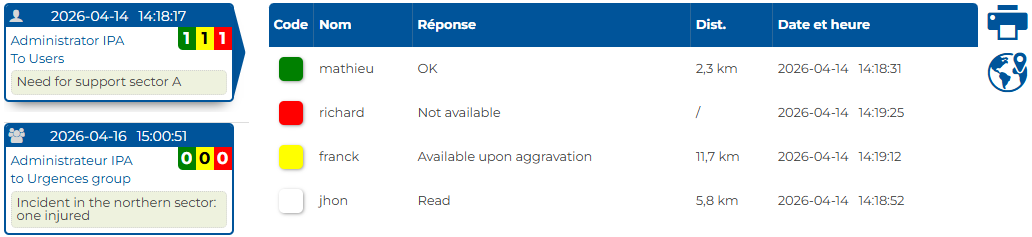
IPA identifies the active on-call employee, routes the alert to their phone (app + SMS in parallel). Confirmation « On my way », navigation to site, immediate departure.
-
Tracking & cascade
Supervisor tracks status, time, geolocation live. No answer in 5 min? Auto cascade to backup. Full history for the municipal report.
One alert, one tap, one response
The app supports every municipal role — on-call employee, department head, supervisor — from notification to intervention:
- Cuts-through alarm. Dedicated ringtone of choice, strong vibration, overrides silent and Do Not Disturb. SMS and voice call backup if the app does not respond. Guaranteed wake-up at 3am.
- Acknowledge with one tap. From the notification: « On my way » / « On the road » / « Unavailable ». No need to open the app or log in.
- Automatic navigation. After accepting, the route to the intervention site opens directly in the phone's navigation.
- Personal management. My groups (water, sewer, arena, public works...), on-call calendar, ON/OFF switch for leave or training.
- Role-based access rights. Employee, department head, supervisor, municipal admin — each user sees and does what their role allows.
Cuts-through alarm
Even on silent / DND
- Dedicated ringtone
- Overrides silent + DND
- SMS & voice backup
Ack in 1 tap
From the notification
- On my way / On the road / Unavailable
- No need to open the app
- No login required
Auto navigation
To the intervention site
- Automatic route
- Opens in phone navigation
- After acceptance
My settings
From your phone
- My municipal groups
- On-call calendar
- ON / OFF switch
Role-based access rights
employee · department head · supervisor · municipal admin
100+
Quebec fire services already run on IPA — utilities add-on at unified preferential pricing
IPA features activated in this sector
Frequently asked questions
How do you receive alerts from isolated infrastructure?
Any channel: phone with DTMF code (numeric), SMS, email, HTTP webhook, SCADA emails. We adapt reception to your existing equipment, even the oldest. Each group has its own intake channels.
Can we keep legacy equipment (pagers, numeric codes)?
Yes. IPA cohabits with your existing fleet: pagers keep beeping, radios stay in service, numeric code systems remain functional. IPA just adds modern channels (app, SMS, voice) in parallel. Transition happens at your pace.
Can we cover several infrastructure types with a single system?
Yes. Create as many groups as needed: Water, Sewer, Public Works, Buildings, Arenas, Street Lighting. Each group has its on-call schedule, preferred channels, cascade rules. Your employees only receive what concerns them.
How does pricing work?
Per-enrolled-user pricing, from $4 / user / month. Unified preferential pricing if your city already runs IPA for its fire service: one contract, multiple departments. For large cities, a usage-based model is also available.
How long to deploy?
Account created in minutes. Groups and schedules setup: 30 min to 1 hour per department. Integration of existing alert sources (SCADA, telemetry): a few hours per type. Our team supports you throughout.
Can we test before committing?
Yes. Free trial with no limit or commitment, on a pilot department of your choice. Validate relevance before extending to other services. Onboarding support included.
365 × 24/7 support — infrastructure in Quebec
The solidity a critical infrastructure demands.
24/7 human support
Our team is reachable at all times. No bot, no lost ticket — engineers who know your deployment.
Hosting in Quebec
Servers located in Quebec, compliant with Quebec's Bill 25. Your data stays on Canadian soil.
Redundant infrastructure
Redundant servers, encrypted backups, 24/7 monitoring. Availability is our foremost commitment.
Try IPA for your city — no commitment
Full account created in minutes. Start with a pilot department — water, arena, or other — and validate before extending. Unified preferential pricing if you already have a fire service equipped. Your turn?